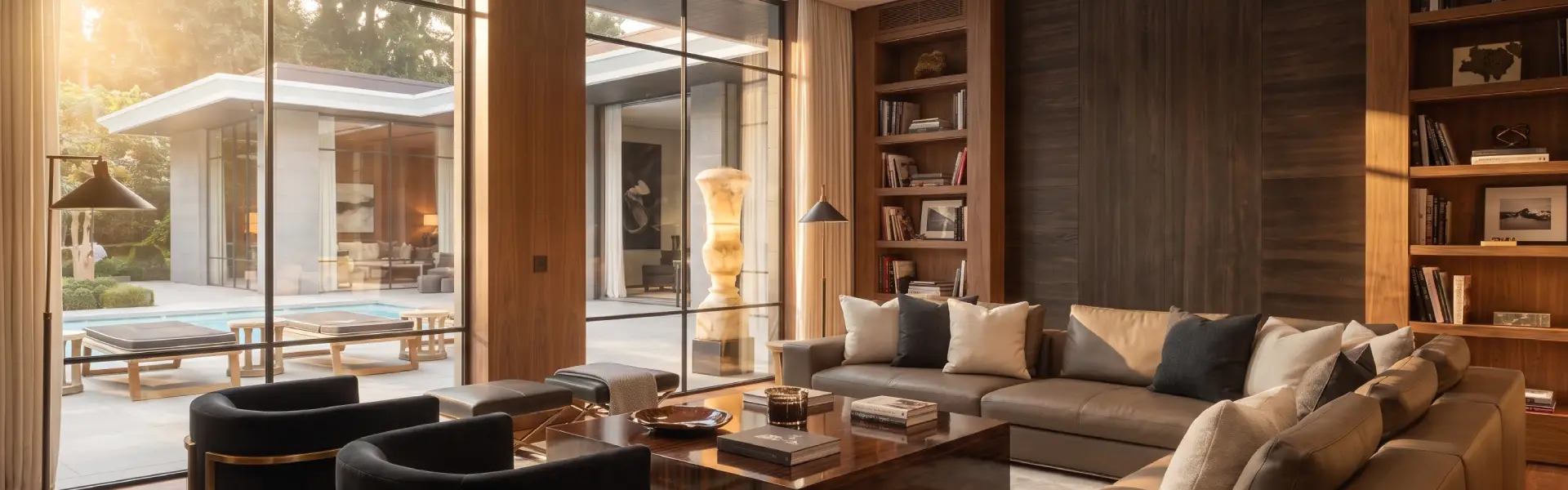

A luxury interior is measured neither by the number of objects it contains nor by their price, but by the rightness of what remains. It is a space where the materials are true, the proportions exact, the light considered, and where every element has been chosen rather than endured. Between the temptation of absolute restraint and the pleasure of decoration, the real question is not “minimal or decorative?” but “when to add, and when to take away?”. It is this judgement, room by room, gesture by gesture, that separates a beautiful interior from a right one.
“Luxury is what you decide not to put in,” says Laurent Galle. “A client never asks me for more objects. They ask me for more calm, more light, more meaning. The rest follows.”
What defines a luxury interior today?
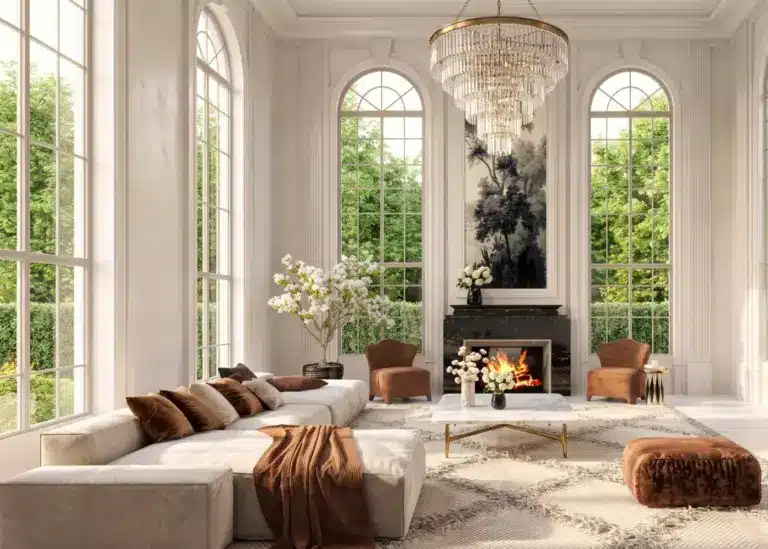
A luxury interior is a space where quality takes precedence over quantity: noble, durable materials, craftsman-level execution, invisible bespoke work, and acoustic and lighting comfort. The definition has changed. In the 1980s and 1990s, luxury announced itself, gilding, showpiece marbles, conspicuous signatures. Over the past fifteen years, the movement has reversed: quiet luxury, championed by figures such as Vincent Van Duysen, John Pawson and Axel Vervoordt, has shifted the emphasis from display to sensation.
In practice, four markers never lie:
Material
Honed stone rather than polished, brushed solid oak, lime plaster, washed linen. Luxury is felt before it is seen.
Proportion
Uncluttered ceilings, generous circulation, joinery aligned to the millimetre. This is the architect’s work that precedes any decoration.
Light
Never a ceiling riddled with spotlights. Low, indirect, dimmable sources, light that sculpts instead of flooding.
Bespoke
A bookcase drawn for this wall, a handle cast for this door. What exists nowhere else.
Nothing in that list demands emptiness.
Nothing forbids decoration. Luxury is a standard, not a style.
Is minimalism the same thing as luxury?
No, and this is the most widespread misconception. Minimalism is a grammar; luxury is a level of exigence. You can be minimalist and poor in sensation: a white, empty, badly lit space is not a luxury interior; it is an unfinished one. Conversely, a densely decorated drawing room, of the kind Jacques Grange or François Catroux knew how to compose, can reach absolute refinement, because every object in it is in dialogue with the others.
True minimalist luxury is, paradoxically, the most expensive kind: when there is almost nothing, everything shows. A bare wall demands a flawless plaster finish. A room without mouldings demands impeccable shadow gaps. John Pawson has been saying it for thirty years: restraint forgives no approximation. Taking away often costs more than adding.
“When a client tells me ‘I want minimalist’, I translate: they want visual silence,” Laurent Galle explains. “But silence does not mean absence. A successful minimal room contains exactly as many intentions as a decorated one. They are simply hidden in the details.”
When should you take away?
Take away when the eye no longer settles. That is the first and most reliable signal: if the gaze sweeps the room without finding anywhere to rest, there are too many focal points cancelling each other out. These are the situations where subtraction is called for:
When objects compete
Two strong pieces on the same console weaken each other. A major artwork deserves a wall; three average ones create noise.
When the decor hides the architecture
If a fine ceiling height, an enfilade or a sightline disappears behind furniture, the space is working against itself. Architecture is the first decorative object, and the most precious.
When nothing has a story
Accessories bought “to fill”, vases by the set, books by the metre, throws that are never unfolded, instantly signal an interior composed for the photograph. Remove everything whose provenance you cannot tell.
When upkeep becomes servitude
A luxury interior is lived in. If the decor imposes a daily inconvenience, it has outgrown its purpose.
The most effective method remains the temporary void: take out everything that is neither functional nor structural, live in the bare room for a few days, then reintroduce one object at a time. What is not missed does not come back.
When should you add?
Add when the room is mute. A space can be perfectly proportioned, materially irreproachable, and say nothing. The signals that call for addition:
When there is no focal point
Every room needs a visual centre of gravity: an artwork, a fireplace, a sculptural pendant, a collectible piece of furniture. Without it, the eye wanders and the space feels cold, however fine its quality.
When all the materials look alike
A single-material interior, all pale wood, all mineral, tires through uniformity. Add the counterpoint: a bronze in an oak setting, a velvet in a world of linen, a rough ceramic on smooth marble.
When there is no trace of life
The most moving interiors published by AD share one thing: you can tell who lives there. A library that is actually read, a sincere collection, an object brought back from a journey. It is the opposite of staging and irreplaceable.
When evening light does not exist
Many interiors are designed for daytime and die at 8 p.m. Add low sources: table lamps, adjustable wall lights, candles. Evening light is the most affordable of luxuries.
The stopping rule is simple: add one element, step back, look. If the room “answers” if it has gained tension, warmth or character, stop there. The next gesture is almost always one too many.
How do you strike the balance, room by room?
The balance between minimal and decorative is not a global setting: it is calibrated room by room, according to use and the rhythm of the house.
The entrance hall carries decoration well: it is a room of passage, a stage. A strong artwork, an antique mirror, a sculptural console all belong there without ever tiring the eye, since no one lingers.
The living room demands the right tension: one or two focal points, generous seating, materials in counterpoint. It is the room of balance par excellence, neither gallery nor waiting room.
The bedroom leans minimal: sleep calls for visual silence: soft materials, a narrowed palette, low light. The only decoration that matters is what you see from the bed.
The kitchen and bathrooms call for functional minimalism, but in the noblest material possible, because these are the rooms you touch the most.
The library or study is the natural territory of the decorative: the room of legitimate accumulation, of objects that tell stories.
“I often tell my clients to think of their house as a sentence,” Laurent Galle notes. “You need silences for the words to carry. A house that is entirely decorated shouts; an empty house says nothing. Between the two lies the right tone, and it is different for everyone.”
The mistakes that give away fake luxury
Certain signs instantly betray an interior that imitates luxury without reaching it: the accumulation of branded pieces with no dialogue between them (the “inhabited catalogue”); uniform overhead lighting, which flattens everything it touches; imitation materials, faux marble, faux brass, faux linen, which age badly and show up close; the total look of a single era or a single manufacturer, which freezes the room into a showroom; and emptiness mistaken for minimalism, when the absence of choice disguises itself as a design stance.
The remedy is always the same: return to the original question. This object, this material, this light- is it a choice, or a filler? In a luxury interior, there are only choices.
FAQ — Luxury interiors
What defines a luxury interior today?
The quality of the materials, the precision of the proportions, considered light and bespoke detailing, not an accumulation of expensive objects. Contemporary luxury favours coherence and sensory comfort over display.
Does a luxury interior have to be minimalist?
No. Minimalism is a grammar, not an obligation. A luxury interior can be pared back or richly decorated: what matters is that every element is chosen, in its place, and that nothing is there by default.
How do you know whether to add or remove in a room?
Remove first: anything with no function, no emotional value, no visual role. If the space then feels cold or mute, add one element at a time: an artwork, a material, a lamp, and stop the moment the room “answers back”.
What are the most common mistakes in luxury interior design?
Accumulating branded pieces with no dialogue between them, flooding the room with uniform overhead lighting instead of sculpting light, and confusing emptiness with minimalism; a space is not a considered space.
What budget should you allow for a luxury interior?
The budget depends less on floor area than on the level of bespoke work: custom joinery, natural stone, architectural lighting. In a high-end renovation, most of the investment goes into what you don’t notice at first glance, and that is precisely what makes the difference.
Ready to find the right balance for your home?
Discover how Laurent Galle approaches each project, and start a conversation about yours. Contact the studio