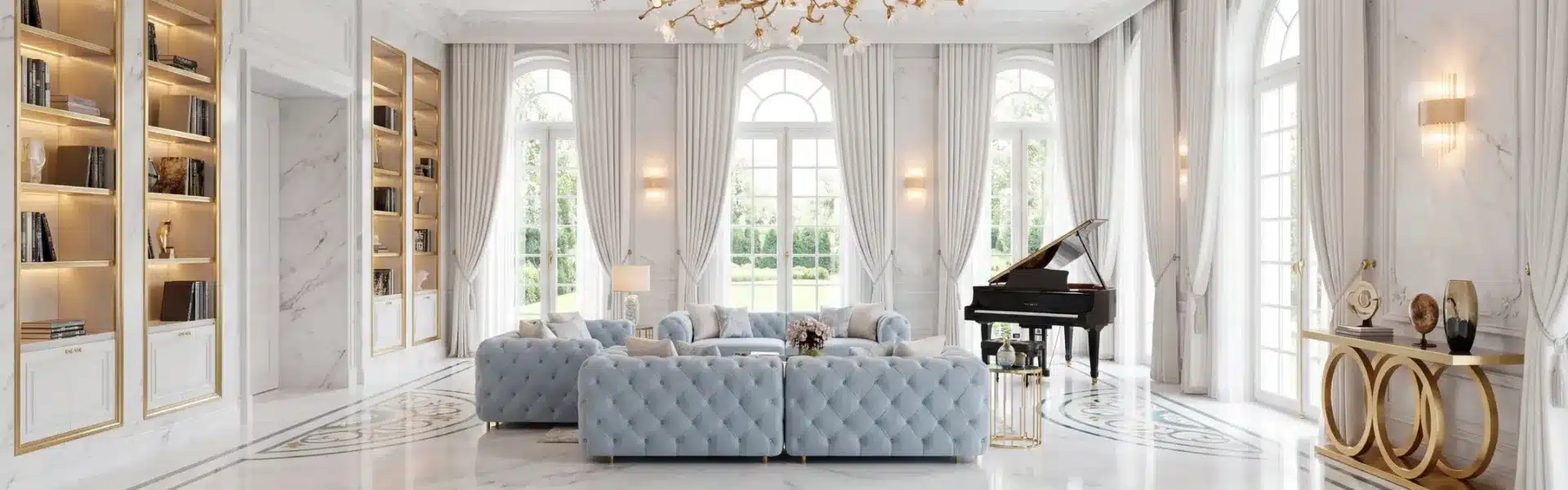

Author: Laurent Galle, Interior Architecture and Decoration Studio
Reading time: 8 minutes | Date: May 2026
For twenty years, I have practised as an interior architect and designer in Paris, answering the same question in ten different languages: “How do the French make their interiors feel so refined and yet so effortlessly natural?” The answer rests on a paradox: French interior design style is not a style at all. It is a philosophy.
It cannot be purchased in a flat-pack from a large retailer. It cannot be applied like an Instagram filter. It is built, layered, and understood. And it is precisely this resistance to easy replication that fascinates, and that sometimes discourages.
This article is an attempt at honest decoding. Not another guide to “French-inspired colour trends”, but a practitioner’s reflection on what makes the essence of a French interior, why it crosses borders with such disarming ease, and above all, how you can draw from it authentically.
What the rest of the world understood before we did
A few years ago, a study by Pinterest revealed that searches related to “French interior design” had increased by 312 % over three years, with remarkable spikes in Japan, South Korea, Brazil, and the United States. Instagram and TikTok accounts dedicated to Parisian apartments accumulate tens of millions of followers. The YouTube channel of an American expat in Paris who simply documents her flat in the 16th arrondissement surpassed two million subscribers in eighteen months.
This phenomenon says something fundamental: in a world saturated by premium Ikea aesthetics and the perfectly calibrated white interiors of Scandinavia or Japan, French interior design style offers something irreplaceable. It offers assumed irregularity. Temporal complexity. The impression that life is genuinely unfolding in these spaces.
“A French interior does not look like a showroom. It looks like a life well lived, several eras layered on top of one another, and that is precisely what makes it universal.” Laurent Galle, interior architect, Paris
What content creators across the world are trying to capture, and variously call the French aesthetic or Parisian style, is not a list of furniture pieces or colour references. It is an attitude towards objects, time, and inhabited space.
The six pillars of French interior design style
After twenty years designing interiors in Paris, London, and New York for both French and international clients, I have distilled what I consider the six invariant foundations of the French interior. They apply as readily to a Haussmann apartment in the 7th arrondissement as to a farmhouse in Luberon, to a contemporary loft as to a 35 m² flat in the Marais.
The mixing of eras as a founding principle
The golden rule, if one exists, is this: never decorate in a single style. An entirely Louis XVI interior is in a museum. An entirely contemporary interior is a showroom. A French interior, however, makes the two coexist, and willingly adds a third era, or even a fourth.
In the apartment I recently completed on the rue de Bretagne, for a family of architects, a bookcase in Directoire-period joinery sits alongside a Pierre Paulin sofa from the 1970s, a solid oak table commissioned from a craftsman in the Morvan, and light fittings designed by my studio. No surface coherence, a deep coherence of materials and intentions.
I call this the dialogue between ages: the space becomes a sensory chronology, not a period catalogue.
Explore more projects on Laurent Galle’s portfolio.
Subdued colour, or the art of non-colours
French interior design style is not white. It is linen grey, plaster off-white, limestone beige, and shutter sage. Colours that seem to flee their own definition. Shades that shift with the hour and the light.
This palette is not a trend born on Instagram. It is the direct consequence of centuries of architecture in white limestone, lime-painted joinery, and natural wool and linen textiles. Geography imposed it before aesthetics claimed it.
The tipping point into cliché occurs when one attempts to reproduce these colours using bright synthetic paints. The French palette demands depth, low saturation, and a slight imperfection in application.
Practitioner’s note: Before committing to a wall colour, observe it at three different moments: at 8 am under natural light, at 1 pm in direct sunlight, and at 7 pm under your artificial lighting. A colour that passes all three tests with grace is a French colour. The others are not.
Noble materials and their patina
Marble, stone, solid wood, linen, wool, full-grain leather, brass, artisanal earthenware. What distinguishes material choices in a French interior is their capacity to age with dignity. A Carrara marble table bearing the marks of twenty years of meals is, in my view, more beautiful than a new one still wrapped in protective film.
This philosophy of materials stands in direct opposition to the culture of pristine newness that dominates much of international decoration. It requires accepting, even seeking, the marks of time as a form of added value.
In practice, this means: consistently choosing the original over the reproduction, the artisanal over the industrial, the unique piece over the limited series that imitates uniqueness.
Natural light as a building material
Nowhere else have I seen light handled as carefully as in the French interiors I most admire. Not as a staging effect or a photographer’s trick, but as a material in its own right, as fundamental as the floor or the walls.
This manifests in choices that might seem incidental: the height at which a curtain is hung (always floor to ceiling, never halfway), the weight of the chosen fabric, the colour of the window reveals, and the absence of any obstruction between the window and the room. And, fundamentally, the courage not to fill every corner, to leave the space it needs to circulate freely.
Books as interior decoration
In Anglo-Saxon and Nordic countries, books are decorative accessories, turned spine-inward to hide their titles, or selected for the colour of their covers. In France, books are infrastructure.
A French bookcase is disordered, overfilled, and personal. It mixes formats, genres, and generations. It betrays its owner more completely than any other object. And it is precisely this autobiographical quality that gives French interiors their particular texture, the impression of inhabiting someone’s mind rather than simply their apartment.
The je-ne-sais-quoi of deliberate incompleteness
This is the most difficult pillar to convey, and yet the most decisive. I call it deliberate incompleteness. A French interior always appears slightly in progress, never frozen in its definitive version.
This is not carelessness. It is a higher form of sophistication that understands clinical perfection as the surest sign of a space that is not truly lived in. A slightly displaced cushion, an open book on a coffee table, a vase without flowers, or with wilting ones, these micro-signals of ongoing life are intentional, or should be.
“The worst enemy of French style is over-perfection. The moment an interior resembles its own photograph, it is dead.” — Laurent Galle
What distinguishes Parisian style from French interior design style?
The question arises often and deserves a precise answer. When we speak of French interior design style, we are not speaking only of Haussmann apartments in Paris, with their plasterwork mouldings, herringbone parquet, and marble fireplaces, even though this model is the most photographed and most imitated in the world.
France is a country of regions, and each region has developed its own interior vocabulary:
Provence brings its ochres, dried lavender, terracotta tomette floor tiles, and sun-bleached blue shutters.
Normandy imposes its half-timbering, Toile de Jouy fabrics, inherited silverware, and plaster-set exposed beams.
The Basque Country plays on ox-blood red, lime-washed white, and carved lintels.
Burgundy unfolds in tones of golden stone, converted vaulted cellars, and worn trestle tables.
Bordeaux and the South-West marries treated maritime pine with striped Basque fabric and the rigour of ashlar stone facades.
What unites all these regional expressions is what I call the culture of beautiful utility: the profoundly French idea that everyday life deserves the same care as the extraordinary. That the morning coffee pot, the evening glass, the chair on which one spends ten hours a day, all of these things deserve to be beautiful, well-made, and lasting.
The classic mistakes and how to avoid them
For someone who did not grow up in this world, adopting the French interior design style comes with well-documented pitfalls.
Confusing the symbol with the style
The symbol is the gilded Eiffel Tower on the bookshelf. The cheap Impressionist reproduction. The “Paris” tea towel hung as decoration. These are cultural shortcuts that signal a desire to appear French without understanding its codes, and ones that the French themselves never use in their own homes.
Style, by contrast, lives in the way materials meet. In the relationship between the window and the wall. In the scale of furniture relative to the room. These are questions of proportion and intention, not iconography.
Buying everything at once
A French interior is built over time. It accumulates pieces found in brocantes, inherited from grandparents, brought back from travels, and commissioned from craftspeople. This temporal sedimentation cannot be simulated over a single weekend in a large furniture retailer.
My practical advice: begin with three pieces you genuinely love, a table, a lamp, a painting, and build around them. Let the rest arrive at its own pace.
Over-decorating out of fear of emptiness
Emptiness is a French luxury. A bare white wall is not a shortcoming; it is a decision. An unoccupied corner is not an oversight; it is a breathing space. The temptation to fill everything betrays a decorative anxiety that successful French interiors have entirely dissolved.
The two-thirds rule: Once a room feels finished to your taste, remove approximately one-third of the decorative objects you have placed in it. Store them for a month. If at the end of the month you have not missed them, they had no place there. This is a rule I apply systematically in all my Parisian projects.
Neglecting lighting
In France, one does not simply illuminate a room: one creates atmospheres. This implies a large number of low-intensity light sources, very few overhead fixtures, never cold LED light, and a reflection on the direction of light that precedes any choice of lamp or fitting.
Building your own French interior
I will close with what I say to every client who hands me an empty apartment and asks me to decorate it “in the French style”: French interior design style is not a final state. It is a process.
That process begins with a simple question: what do I genuinely want to keep of my life in this space? Not what magazines recommend. Not what photographs well on Instagram. What holds value for you, emotionally, intellectually, sensorially?
From there, choices of materials, colours, and furniture become less aesthetic decisions than logical consequences. And it is precisely this intimate coherence, this impression that every object was inevitable in this space, that gives the finest French interiors their singular quality.
It is not a style. It is a way of inhabiting.
If you would like to discuss a project with the studio, you are welcome to get in touch.
Frequently Asked Questions
What is French interior design style?
French interior design style is characterised by a subtle balance between old and contemporary, a palette of subdued and nuanced colours (linen, stone, chalk, sage), authentic materials such as marble, solid wood, and linen, and a commitment to creating spaces that tell a story rather than follow a trend. Its six pillars are: the mixing of eras, subdued colour, noble materials, light as a building material, books as architecture, and deliberate incompleteness.
Why is French interior design style admired around the world?
French interior design style is globally admired because it embodies a philosophy of living: preferring quality over quantity, authenticity over ostentation, and the patina of time over clinical perfection. In a world saturated by perfectly calibrated minimalist interiors, it offers an alternative that conveys the impression of a life truly lived.
How do you adopt French interior design style without resorting to clichés?
To adopt French interior design style without clichés, avoid tourist iconography and focus on the fundamentals: mixing eras with intention, choosing quality natural materials, embracing emptiness, incorporating books as genuinely personal decorative elements, and above all, not buying everything at once. Time is your greatest ally.
What is the difference between Parisian style and French interior design style?
Parisian style, with its Haussmann mouldings, herringbone parquet, and marble fireplaces, is one particular expression of French interior design. The broader French interior aesthetic also encompasses Provençal, Norman, Basque, and Bordelais styles. What unites them all is a deep culture of beautiful utility and care for the everyday living environment.
What colours define French interior design style?
The French interior palette consists of low-saturation, high-depth tones: linen grey, plaster off-white, limestone beige, shutter sage, and Provençal ochre. They are best applied in lime or casein-based paints rather than synthetic finishes, and should always be assessed at different times of day before any final commitment.