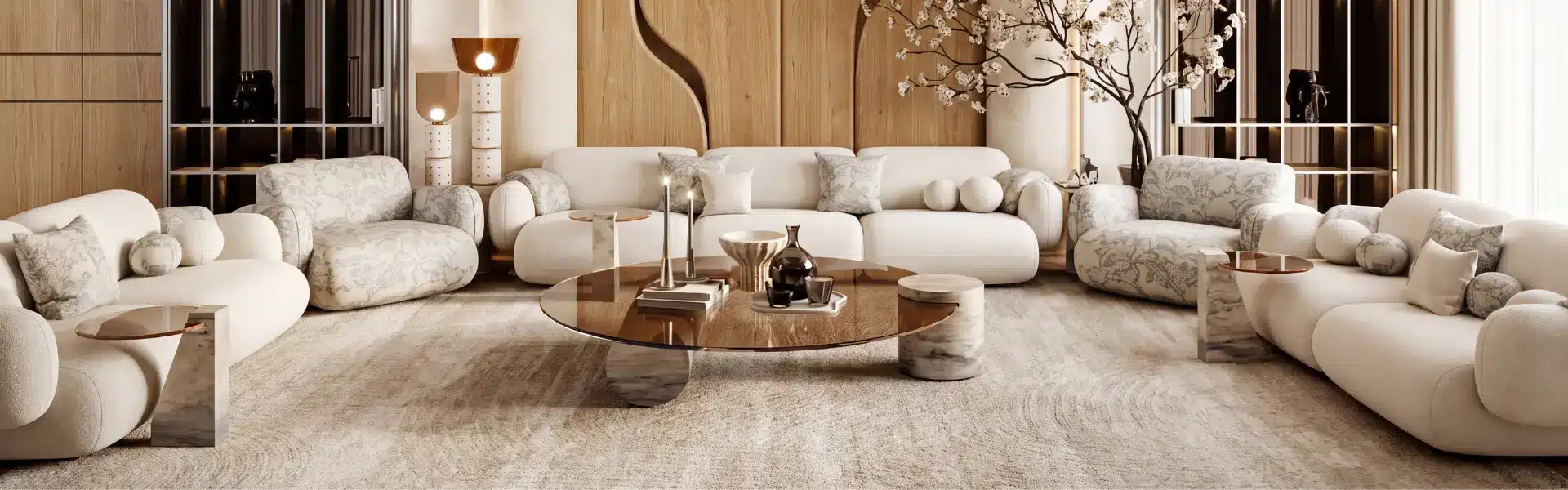

A room can hold designer pieces, rare materials and a serious budget, and still ring false. In high-end interior design, what cheapens a space rarely comes down to the price of the objects: it is almost always a matter of miscalibrated proportions, neglected lighting, materials that betray themselves, and a missing through-line. The mistakes below appear in most supposedly luxurious interiors, and the way decorators correct them usually comes down to a handful of invisible gestures.
Luxury is not accumulation. It is coherence.
What is high-end interior design, exactly?
High-end interior design refers to a scheme in which every decision, material, proportion, light, and circulation answers to a single, overarching intention, and in which quality of execution matters more than visible signs of wealth. What sets a great interior apart is not the number of branded objects, but the precision with which they speak to one another.
This is precisely why an expensive interior can still look cheap: the eye, even an untrained one, senses the dissonance before it can name the cause. Here are the most common faults, and the easiest to avoid.
Why does lighting make (or break) a room?
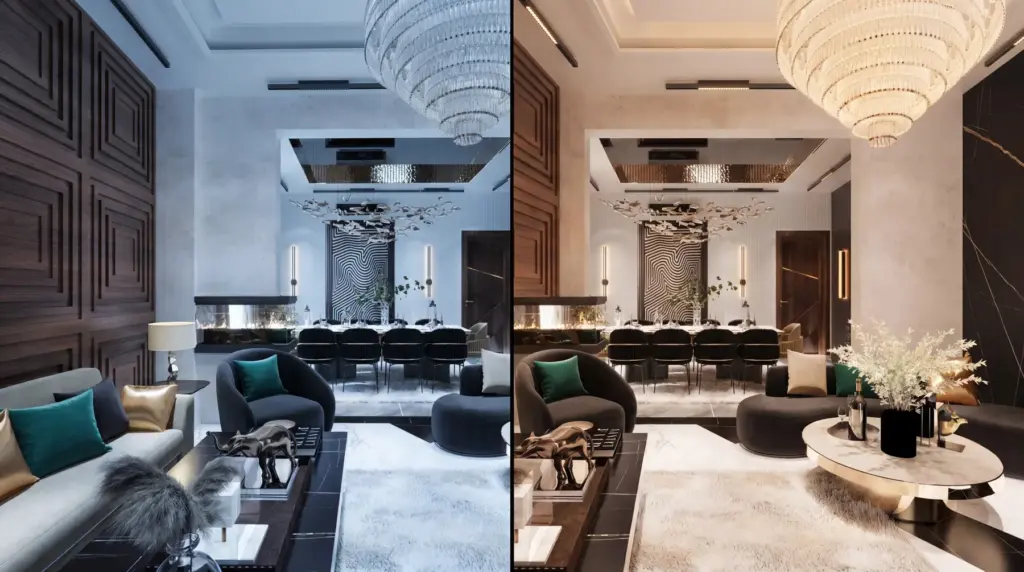
This is the most widespread mistake, and the most costly to a room’s presence: handing the lighting of an entire space to a single source overhead, usually cold, usually too bright. Flat, uniform light flattens volumes, kills the texture of materials, and exposes everything an interior should suggest rather than display.
A high-end interior is conceived as layered lighting: several sources, at several heights, at adjustable intensity. A floor lamp for verticality, table lamps for the warmth at eye level, wall sconces to give the walls rhythm, indirect light to carve out the corners. Colour temperature stays around 2,700 K, the warmth of a flame, never the whiteness of an office. And dimmers, everywhere, are not a luxury but a grammar.
The recessed-spotlight “starry sky,” meanwhile, remains the signature blunder of interiors that believe themselves modern: it perforates the ceiling, sets no hierarchy, and betrays the absence of a point of view.
Mishandled proportions: The too-small rug, the floating furniture
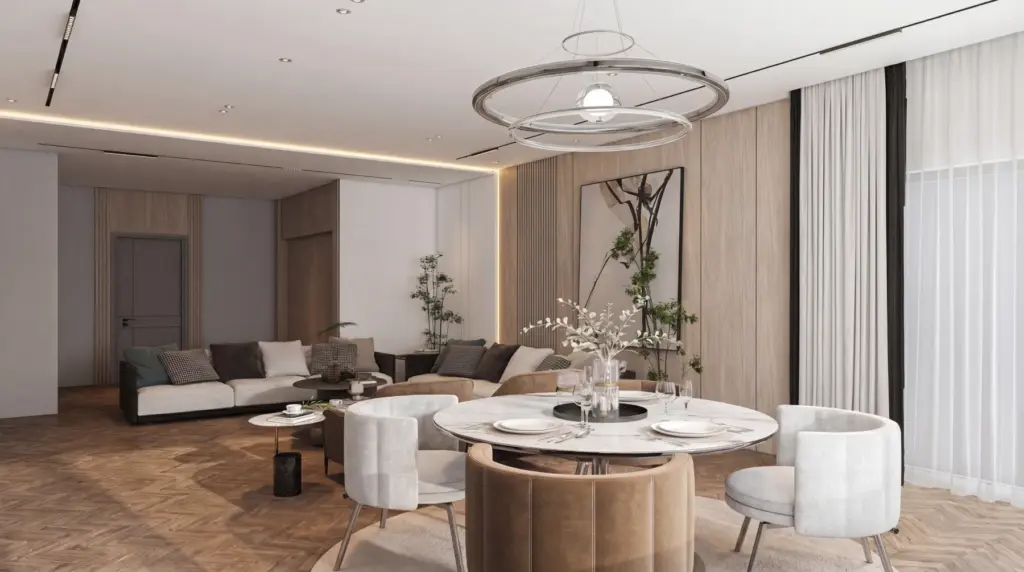
Nothing devalues high-end interior design as reliably as an error of proportion. The textbook case: the undersized rug, dropped like a postage stamp in the middle of the living room, on which not a single sofa leg actually rests. The result is a space that seems to fold in on itself, oddly detached from its own furniture.
The decorator’s rule is simple: the rug should hold, at minimum, the front legs of the seating; ideally, the furniture sits entirely upon it. The same goes for a console hung too low beneath a mirror, a coffee table lost in the middle of a large sofa, or curtains mounted level with the window rather than as high as the ceiling allows. Each is a calibration fault that shrinks a room and strips it of its bearing.
A well-decorated volume is one in which every object is the right size for its role, neither timid nor overbearing.
Materials that ring false
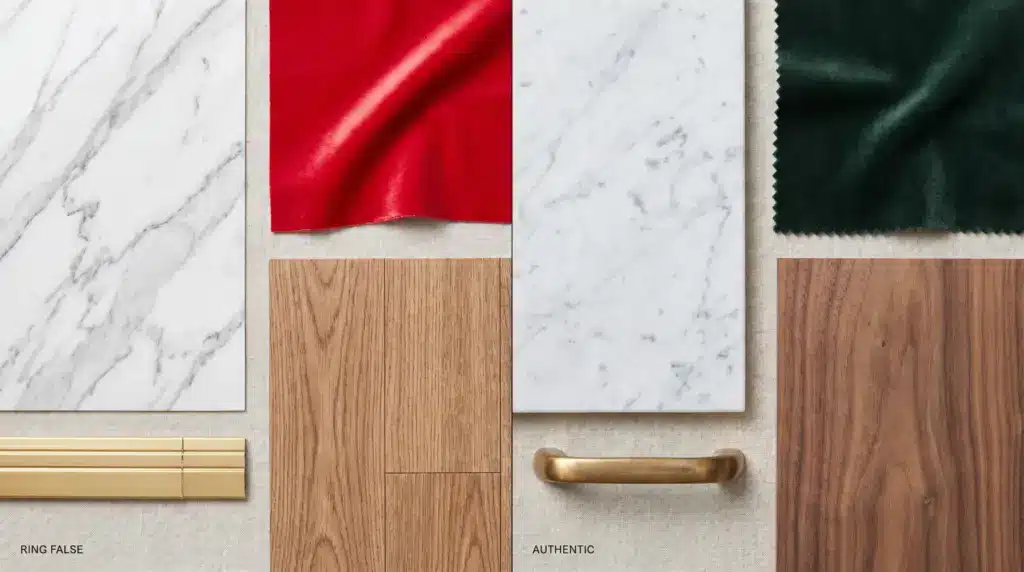
One can forgive restraint; one rarely forgives the fake. The veneer imitating marble, the faux leather miming hide, the gilt that flakes, the lacquer that sounds like plastic: these materials betray the whole, even when they sit beside genuine pieces. And therein lies the paradox of the high-end: a single fake contaminates the real things around it.
A modest material, honestly used, beats a noble one merely simulated. Beautiful raw wood, washed linen, plain stone, patinated metal are all worth more than their flashy counterfeits. Touch matters as much as sight: an exceptional interior is recognised by the hand as much as by the eye.
The showroom effect: When everything is bought at once
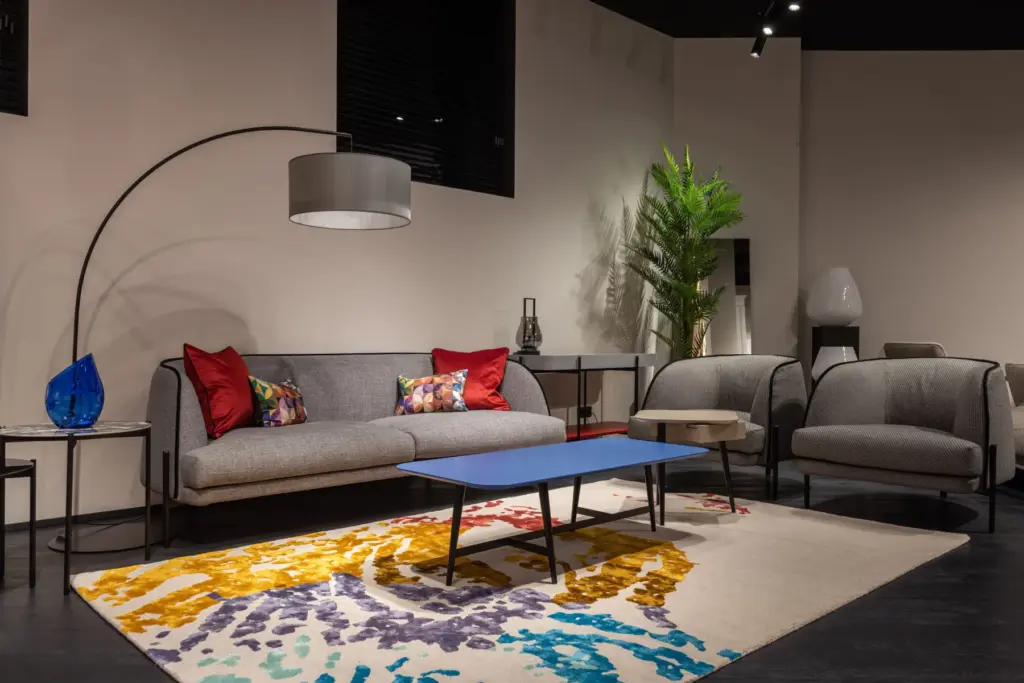
An interior composed entirely in one go, from one brand, from one collection, produces an immediately recognisable effect: the catalogue. Everything matches, everything answers everything else, and for exactly that reason, nothing speaks. What is missing is what decorators call the narrative, that layering of periods, origins and memories that gives a place a depth impossible to buy in a single afternoon.
High-end interior design is built over time, in layers: a flea-market find beside a contemporary piece, a family heirloom next to a bespoke commission, a work brought back from a journey. The mix is not disorder; it is a signature.
The all-over trend that dates before it's finished
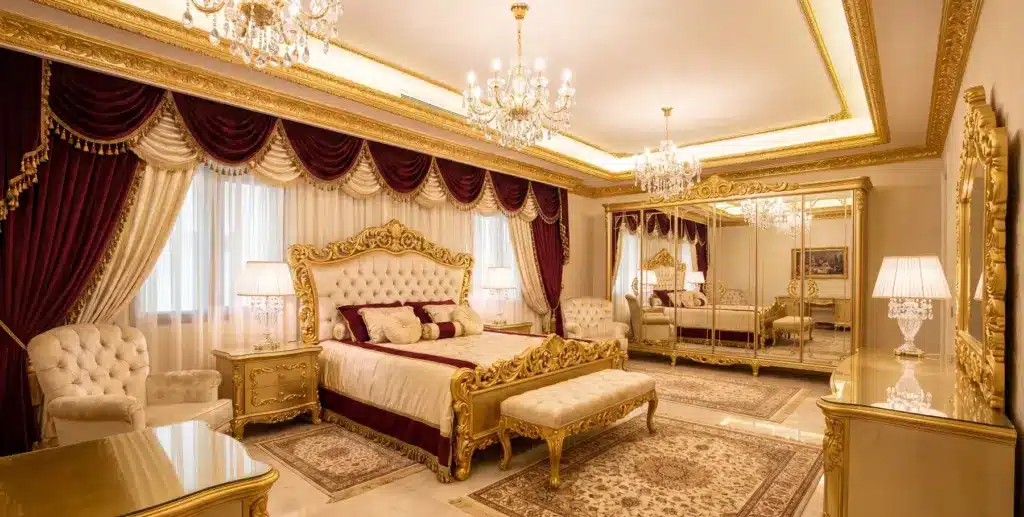
Adopting a trend wholesale, cane webbing everywhere, travertine floor to ceiling, the colour of the year on every surface, is a way of dating an interior the very day it is completed. An overdone trend becomes a fashion, and a fashion always ends up belonging to one specific season.
Interiors that last rest on a timeless framework, right proportions, noble materials, controlled light, which is then refreshed with small, easily renewable touches: a cushion, a ceramic, a light fitting. The trend is invited in; it does not dictate.
Badly hung curtains and pictures: The details that give you away
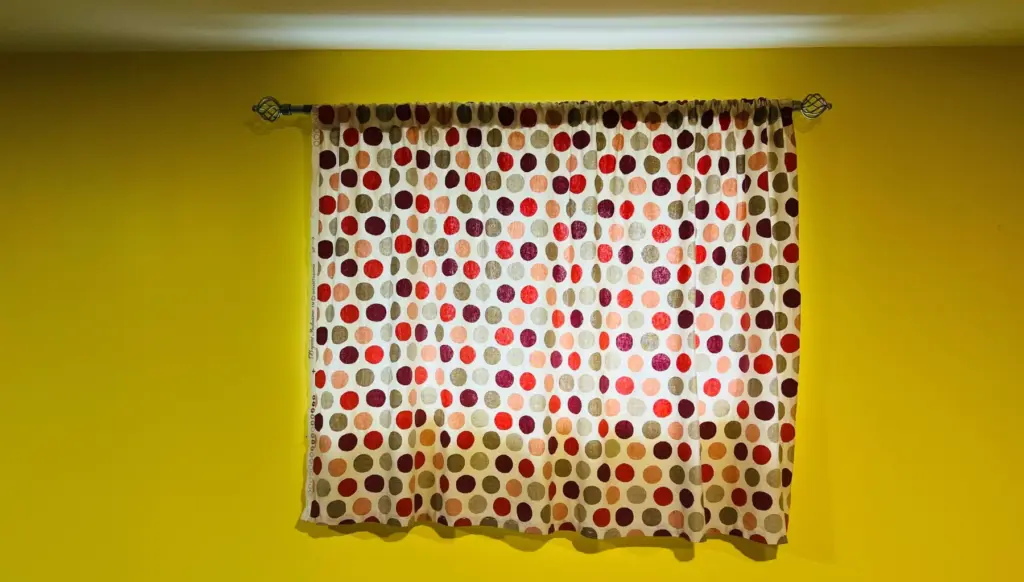
These are the faults a professional eye catches in a second. The curtain hung too short, stopping above the floor like ill-tailored trousers, where it should kiss the parquet, or even “break” by a couple of centimetres. The frame hung too high, lifted out of the line of sight, when the centre of a work should sit at eye level (roughly 145–150 cm / 57–60 in from the floor).
The same principles apply to the rod, mounted as high as possible and extending well beyond the window to let in all the light, and to gallery hangs, which call for a considered alignment rather than an improvised one. These details cost almost nothing. Neglecting them, however, costs all the elegance.
Neglecting the fifth wall and the technical details
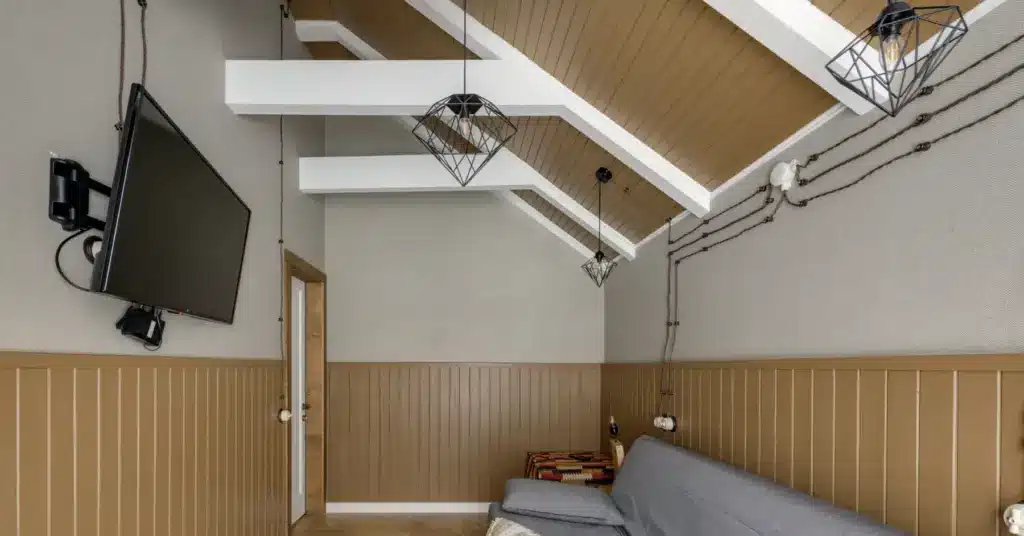
An exceptional interior is also judged by what you don’t look at first: the ceiling, the fifth wall, too often left white by default, when a cornice, a muted tone or a texture could transform the way a volume reads. And then there is all the technical hardware: cheap switch plates, badly placed sockets, exposed conduit, air-conditioning units fitted without integration, visible cables.
The high end lives precisely in that discretion: a brushed-brass switch, a socket aligned to the tiling layout, a hidden light source. It is these finishes, invisible at first glance, that separate a beautiful interior from a great one.
How do you restore value to a high-end interior?
Reviving an interior rarely means redoing everything. Three levers are usually enough to transform how a space reads: rework the lighting (multiply the sources, warm the light, add dimmers); correct the proportions (the right rug, curtains to the ceiling, recalibrated furniture); and edit rather than add (remove the superfluous so the rest can breathe). In design, luxury is often a matter of subtraction.
Frequently asked questions
What devalues a high-end interior the most?
A single, cold overhead light, mis-calibrated proportions (a rug that’s too small, curtains that are too short) and the use of imitation materials. These three faults alone are enough to make an expensive interior look cheap.
How can you tell whether an interior is truly high-end?
By its coherence, not its accumulation. A high-end interior is recognised by the rightness of its proportions, the quality of its light, the authenticity of its materials and a clear through-line, rather than by the number of visible branded objects.
Do you need a large budget to avoid these mistakes?
No. The most common faults- badly hung curtains, pictures placed too high, single-source lighting, an undersized rug- can be corrected on a modest budget. Perceived value rests far more on the rightness of the gestures than on the cost of the objects.
Why does my interior look “showroom”?
Because it was most likely composed all at once, from a single collection. Introducing pieces from different periods and origins, flea-market finds, bespoke commissions, heirlooms, brings the depth and narrative that a too-matching scheme lacks.
Is all-white a mistake in high-end design?
Not in itself, but white by default, chosen out of caution rather than intent, robs an interior of depth. Colour, even muted, and a worked ceiling give character without slipping into a passing fashion.
Refining an interior is, above all, a matter of perspective. For more than thirty years, the Laurent Galle studio has been composing bespoke interiors for private residences, hotels, and boutiques where every proportion, every material, and every source of light answers to a single intention.
If you wish to discuss a project, a renovation, a complete redesign, or simply a considered eye on an existing space, our team welcomes you by appointment.