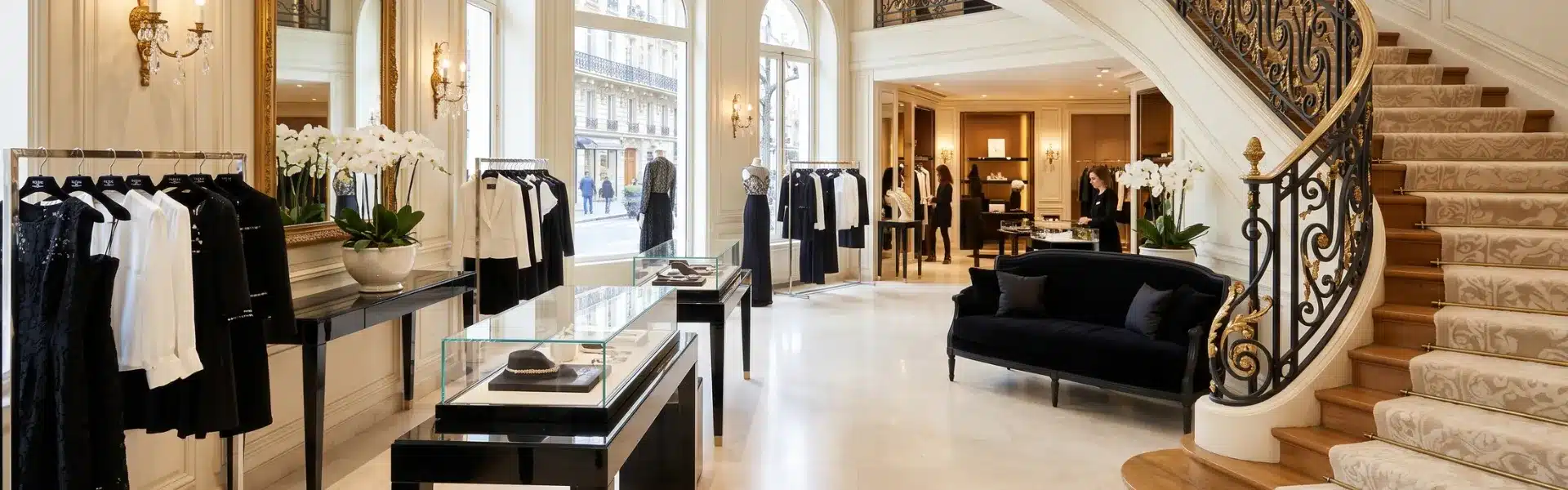

A luxury retail interior designer conceives and delivers commercial spaces that translate a brand’s aesthetic codes into a physical environment.
Their scope covers spatial planning, technical drawings, material specification, lighting design, contractor coordination, and project delivery. They work with specialist craftspeople, lacquer joiners, leather goods suppliers, bespoke metalworkers, and manage the full chain from concept sketch to handover. For a luxury boutique, this means every surface, threshold, and display unit is a deliberate decision, not a default.
How does interior design increase sales in a luxury boutique?
According to an academic study published on ResearchGate ( Examining the Role of Interior Branding in Retail Design Strategy , 2025), interior design contributes significantly to brand perception, customer satisfaction and business performance, confirming that a well-designed luxury boutique is one of the most powerful levers available to premium brands.
A well-thought-out layout also reduces staff turnover, facilitates the seasonal presentation of collections and extends the lifespan of the space before renovation.
Why does a luxury boutique need spatial consistency with its brand identity?
In luxury, the space is the signature. Every material choice, the grain of the marble floor, the temperature of the lighting, the finish on the display rails, signals something to the client. It confirms or undermines the brand promise before a single word is exchanged.
An interior designer decodes the brand universe and translates it into spatial language. Laurent Galle’s process begins with an immersion phase: understanding the house’s history, codes, and positioning before committing to any parti pris. The result is a space that reads as an extension of the product, not a container for it.
What materials and craftsmanship are involved in luxury boutique design?
Luxury retail demands exceptional materials: lacquered joinery, saddlery leather, onyx, burnished brass, mouth-blown glass. These are not available through standard fit-out contractors. An experienced luxury interior designer maintains relationships with specialist suppliers and artisan workshops that most clients cannot access independently. This network is one of the most underestimated advantages of working with a specialist, it protects both quality and lead times.
When should you bring in an interior designer for a boutique project?
Four situations call for specialist involvement from the start:
Opening a first boutique
The physical project sets the spatial identity of the brand. Decisions made here echo through every future opening. Getting them right the first time is significantly cheaper than correcting them later.
Brand repositioning
When a label moves upmarket or refreshes its visual identity, the retail environment must follow. An interior designer reads the new codes and builds the space that carries them.
Multi-location rollout
Maintaining coherence across Paris, Dubai, and NYC requires a precise design brief and supervised local execution. That is architecture work, not merchandising.
Underperforming space
When sales stagnate despite a strong location and solid product offer, the space is often the problem. A diagnostic assessment identifies the blockers: poor circulation, wrong lighting temperature, awkward proportions, dead zones.
What is the difference between an interior designer and an interior decorator for a boutique?
An interior decorator works on aesthetics: colour, furniture, textiles, accessories. An interior designer works on space itself, moving walls, restructuring volumes, specifying technical systems, and signing off the drawings required for planning permissions. For any boutique project involving structural changes, a full refit, or a building permit, an interior designer is the only professional qualified to carry the process through from start to finish.
How much does an interior designer cost for a luxury boutique project?
Fees for a luxury retail interior designer on a full-service project (concept, technical drawings, contractor coordination, site supervision) typically range from 10% to 15% of total build cost. For a 100–300 m² space in a premium location, that figure rarely exceeds six to eight months of rent, a ratio most luxury brands consider reasonable against the lifetime commercial impact of a well-designed space.
The relevant comparison is not “design fees vs. no design fees.” It is “a space that performs vs. a space that doesn’t.”
How do you choose the right interior designer for a luxury boutique?
Four criteria that matter in practice:
Luxury retail references
The portfolio should contain comparable projects in scale, positioning, and sector, jewellery, watchmaking, ready-to-wear, fine food, niche perfumery. Residential design expertise does not transfer automatically to commercial retail.
Understanding of brand codes
The designer must be willing to subordinate personal style to the brand’s identity. A boutique is not a showcase for the designer’s aesthetic; it is a physical manifestation of the brand’s.
Certified artisan network
Delivery quality and lead times depend on who builds the project. A specialist with an established network in luxury finishes is a concrete operational advantage.
On-site supervision
Strong drawings mean nothing without rigorous site management. Ask how the designer handles contractor coordination and quality control during the build.
What makes Laurent Galle's approach to luxury boutique design distinctive?
Laurent Galle works with luxury houses and premium brands on boutique projects in France and internationally.
His approach combines aesthetic rigour, technical depth, and a direct understanding of the commercial pressures retail clients face. Every project begins with brand immersion and ends with a space that earns its place as a sales environment, not just a designed interior.
Have a boutique project in mind? Get in touch to discuss your brief.