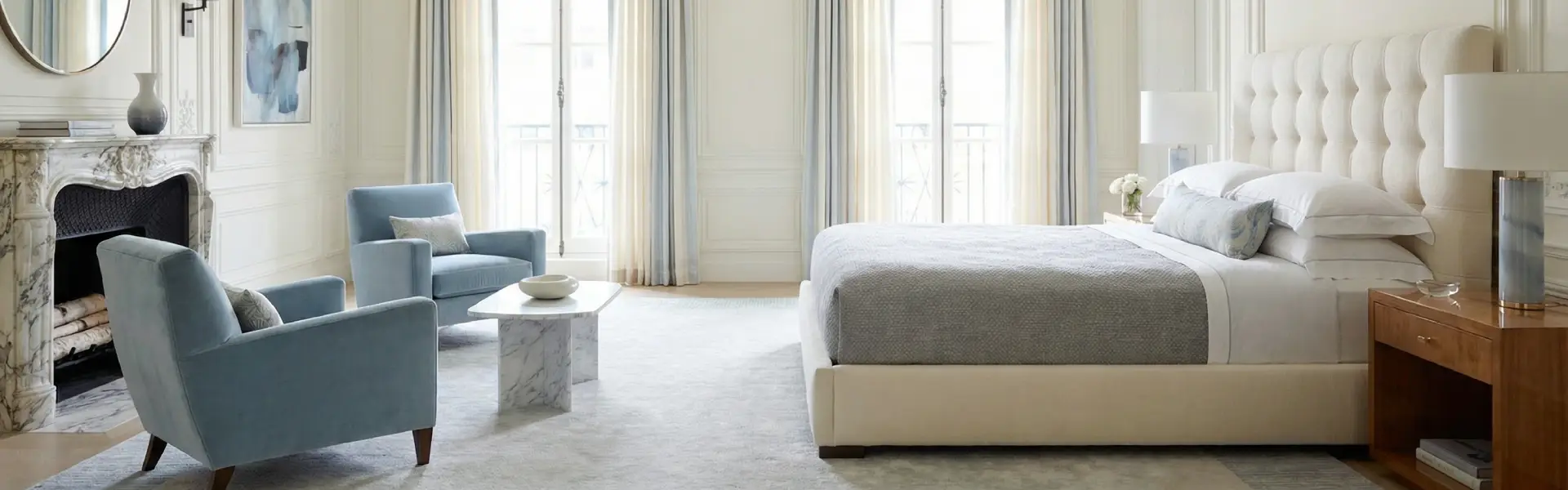

Author: Laurent Galle, Interior Architecture and Decoration Studio
Reading time: 7 minutes | Date: February 2026
Summary
The most effective bedroom decoration ideas do not come from an accumulation of objects, but from a clear and considered reading of the sleeping space. A successful bedroom rests on atmosphere, proportion, and visual clarity. The décor must support rest, not compete for attention. This method draws on seven “structural levers.” They act on perception (light, materials, colour), organisation (storage, circulation), and the hierarchy of the eye (headboard, walls).
Each lever addresses a common problem: a bedroom without depth, harsh evening light, visible clutter, a sense of narrowness, or elements that simply fail to speak to one another. The aim is to improve the bedroom layout through gestures that are simple, coherent, and lasting. The result: a calmer bedroom atmosphere and a more controlled bedroom interior, achieved without major renovation.
Introduction
In the high-end residential projects I design, the bedroom is never treated as a secondary room. It concentrates the challenges of balance, visual comfort, and legibility of volume.
Many bedroom decoration ideas found online remain superficial: changing the bedlinen, adding cushions, hanging wallpaper. Yet a truly successful modern bedroom depends above all on its spatial structure. The interior design of a bedroom must support rest, reduce visual stimulation, and clarify its lines.
Here are the seven levers I use systematically in my projects.
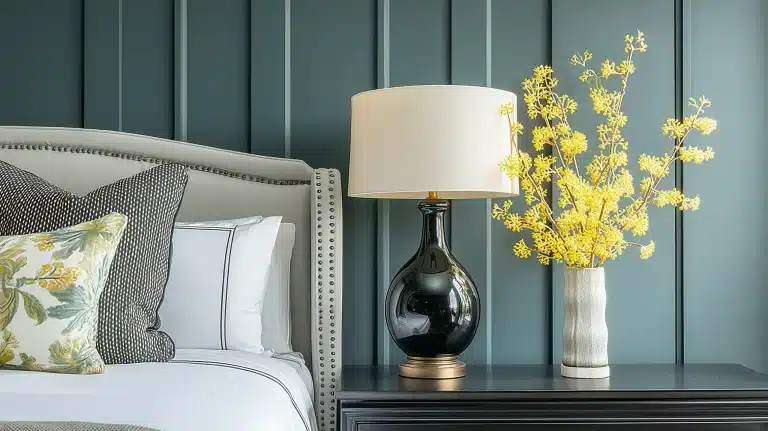
Lighting: Building the atmosphere before the wattage
In a high-end bedroom, lighting is conceived as an invisible architecture. A powerful central ceiling fixture flattens the space and eliminates any sense of depth or relief.
Professional approach
- Layer three sources: soft general lighting, reading light, and indirect ambient light.
- Work at different heights.
- Favour warm colour temperatures (2,700 to 3,000K).
In luxury design, I often integrate cornice lighting or made-to-order wall sconces to frame the headboard area and create a controlled sense of depth.
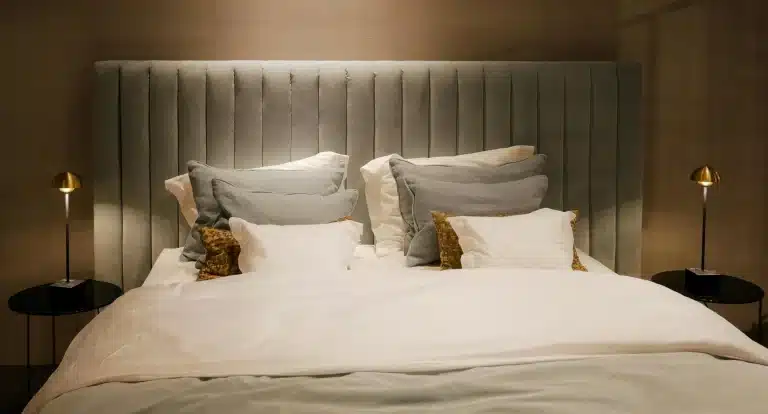
The headboard: Creating hierarchy and anchoring the composition
This lever resolves the problem of a bed that appears to “float,” a principal wall that lacks confidence, and a bedroom that feels provisional. It works because the headboard anchors the entire composition, sets the scale, and structures the sleeping zone, making the whole feel considered and deliberate.
Among all bedroom decoration ideas, the headboard remains the single most important structural element. A bed without visual anchorage creates an impression of something temporary and unresolved.
Architect’s recommendation
- Width at minimum equal to the bed, ideally wider.
- A continuous backdrop: timber, stretched fabric, or a made-to-order panel.
- Precise alignment with bedside tables and integrated lighting.
In high-end projects, I frequently design integrated headboards combining fine textiles, solid timber, or refined veneer, with discreet recessed niches. Avoid a headboard that is too narrow: it makes the bed appear visually heavier and leaves the wall around it feeling more empty, not less.
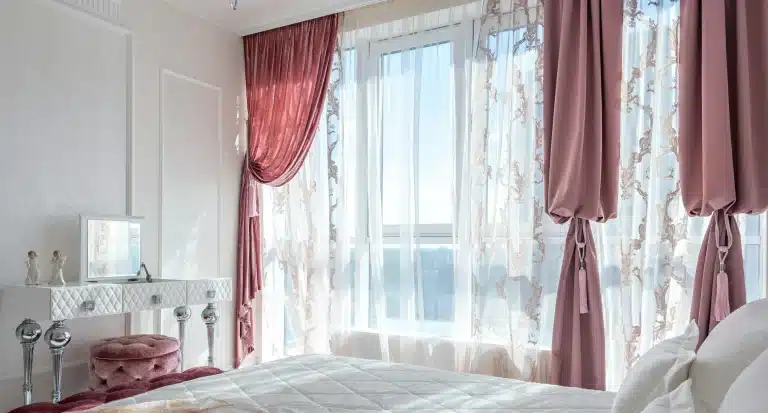
Textiles: Bringing warmth and softening the space
A bedroom can feel hard, echoey, and unwelcoming even with the right furniture if large smooth surfaces dominate. Textiles work because they absorb and soften, while adding texture without visual noise. They also govern the largest visible planes in the room: the bed and the windows.
Keep the execution clean by working with “masses.” Textiles directly shape the bedroom atmosphere. A room can feel cold even with quality furniture if the surfaces remain hard and unrelenting.
Key points
- Quality bedlinen: dense cotton, washed linen, fine wool.
- Full-height curtains, hung high, to increase the perceived ceiling height and stabilise the sleeping zone.
- A coherent, low-contrast colour palette.
In luxury bedroom decoration, natural materials dominate: wool, linen, understated velvet, textured silk. Avoid an overload of patterns and textures: too many competing elements strip the space of its calm and restraint.
Storage: Making calm possible, not merely “tidying up”
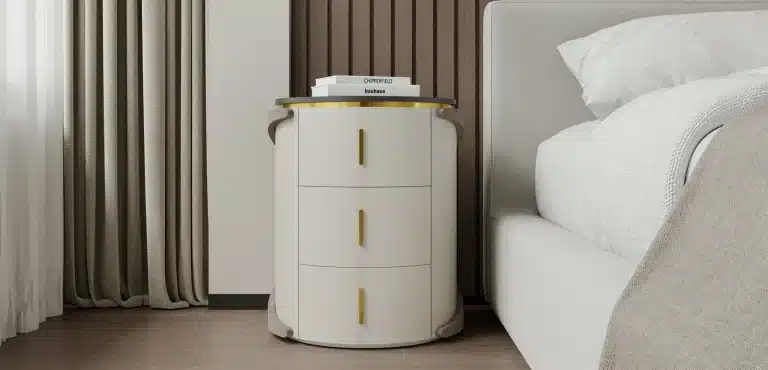
Clutter is never neutral. Even a modest volume of visible objects reduces the room and generates a persistent, low-level tension. A cluttered bedroom can never feel high-end. Storage works best when it becomes an element of composition: it limits visual interruptions, clarifies the surfaces, and keeps the lines of the room readable.
Storage is not purely a practical matter. It is a compositional tool.
Structured approach
- Prefer one generous integrated storage solution over several smaller pieces of furniture: a full-height wardrobe, a wide chest of drawers.
- Prioritise a fluid reading of the space. Multiplying small storage solutions fragments the composition and overloads the room with unnecessary lines.
- Harmonise handles, finishes, and proportions throughout.
In luxury interior architecture projects, made-to-order storage allows volumes to align perfectly and functions to be integrated discreetly. Standardise what remains visible with closed boxes or cohesive containers, so that the whole appears organised rather than managed.
Wall treatment: Framing, adding depth, simplifying
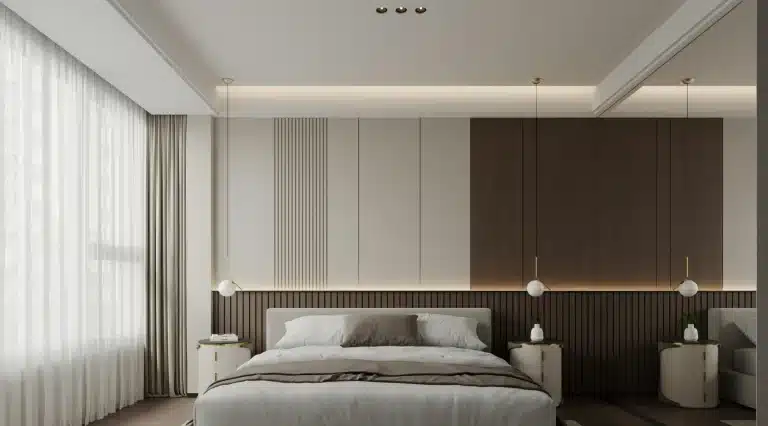
Bedroom walls frequently fall into one of two extremes: entirely neutral, or overloaded with frames and shelving that follow no clear logic. A well-chosen wall treatment works because it creates hierarchy and depth, often with far greater impact than any change of furniture.
Keep control by selecting one priority wall, most often the one behind the bed, and treating it with restraint: a single flat colour, a carefully chosen and measured wallpaper, or one large work of art, or two aligned pieces, rather than a scattered arrangement. Avoid accumulating decorative elements: you replace an empty wall with visual noise, and the composition loses all its force.
A successful bedroom has one clearly dominant wall, almost always behind the bed. In high-end interior design, strength comes from restraint. One structured wall composition replaces a dispersal of decorative objects.
Proportions: Bed, rug, circulation (the foundation)
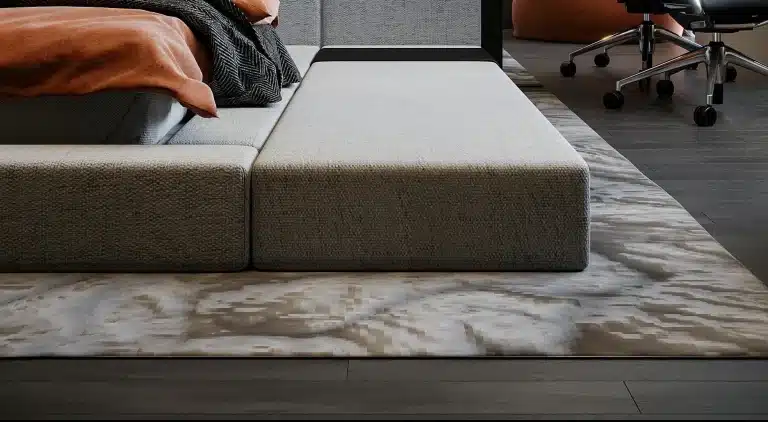
A bedroom often feels uncomfortable not because it is small, but because its proportions are poorly resolved. A tight circulation path, a poorly positioned bed, or a rug that is too small creates an imbalance, even in an otherwise carefully considered interior.
Begin with circulation: you must be able to move around the bed and access storage without constraint.
Then treat the rug as a foundation: it must extend beyond the foot of the bed and along its sides in order to “set” the sleeping zone. If you make only one change, increase the size of the rug. It immediately transforms the reading of the entire room.
Avoid a rug that is too small “to be safe.” It visually contracts the bedroom and gives the impression of an unfinished solution.

Colour palette and restraint: Achieving a modern bedroom without overload
Visual instability in a bedroom most often comes from too many colours that share no clear relationship. A short, controlled palette works because it creates coherence, reduces visual fatigue, and supports rest. In the sleeping space, restraint almost always reads as more refined than excess.
Keep it simple: limit your palette to one dominant tone, one secondary tone, and one discreet accent. Repeat these shades at a few key points, a wall, a principal textile, a piece of furniture, to create a clear thread running through the whole. Slightly muted tones, such as taupe, warm grey, midnight blue, or softened terracotta, support the bedroom atmosphere, encourage rest, and hold together far more effectively than highly saturated colours.
Avoid adding colours without a governing rule: the room then reads as a collection of individual objects rather than a composed whole.
Case study: Renovation of a Haussmann bedroom in Paris
In a 28 square metre Haussmann apartment, the bedroom benefited from a three-metre ceiling height, yet paradoxically the space felt visually low, fragmented, and without clear hierarchy. A central ceiling fixture cast an aggressive light that crushed the volumes. The headboard, too narrow, failed to structure the principal wall. Several small pieces of furniture scattered around the room interrupted the flow of circulation, while an undersized rug reduced the perception of generosity.
The intervention required no major renovation, only a precise recomposition. Integrated indirect lighting set into the cornice replaced the dominant central source, creating an enveloping and more architectural quality of light. A made-to-order headboard in natural textile, spanning the full width of the wall, restored a coherent scale to the sleeping zone. Storage was integrated at full height to eliminate visual clutter and free up the lines of the room. A 240 x 340 cm rug came to structure the whole and anchor the bed within the space. Finally, a reduced palette of warm beige, walnut, and patinated bronze brought unity and depth.
The result now evokes the quiet, intimate atmosphere of a private mansion bedroom: amplified volume, a more serene visual reading, rebalanced proportions. The transformation rests entirely on a mastery of composition, true to a high-end and elegant approach to interior architecture.
Author’s perspective
Generic advice talks about objects. A designer works with space. The difference is visible in the hierarchy: a framed bed, considered lighting, readable volumes, and storage that removes clutter from the field of vision. In a bedroom, quality rarely comes from “style.” It comes from composition.
If the room still resists after applying these levers, the problem generally lies in the layout, whether circulation, the position of the bed, or insufficient storage volume, or in proportional inconsistencies. In that case, a more considered approach, sometimes involving made-to-order elements, delivers a cleaner and more lasting result than a succession of individual purchases.
— Laurent Galle
Conclusion
These bedroom decoration ideas rest on seven structural levers: lighting, headboard, textiles, storage, wall treatment, proportions (bed, rug, circulation), and a restrained colour palette. Together, they transform the sleeping space without major renovation, improving clarity, coherence, and atmosphere.
If you wish to go further, a tailored consultation covering floor plan, materials and colour direction, a designed headboard, and integrated storage delivers a more coherent result with fewer iterations, and a level of finish close to that of a professional project. A well-designed bedroom is not one that shows more, but one that asks less of the eye.
Working with Laurent Galle
For a luxury bedroom decoration project, spatial optimisation, or a full renovation, working with an architect takes the result further: a made-to-order floor plan, art direction, the selection of fine materials, and integrated design throughout.
Laurent Galle guides his clients through the design of calm, well-proportioned interiors, from targeted optimisation to full renovation. You are welcome to get in touch to discuss your space and define the approach best suited to your home.