
Author: Laurent Galle, Interior Architecture and Decoration Studio
Reading time: 8 minutes | Date: March 2026
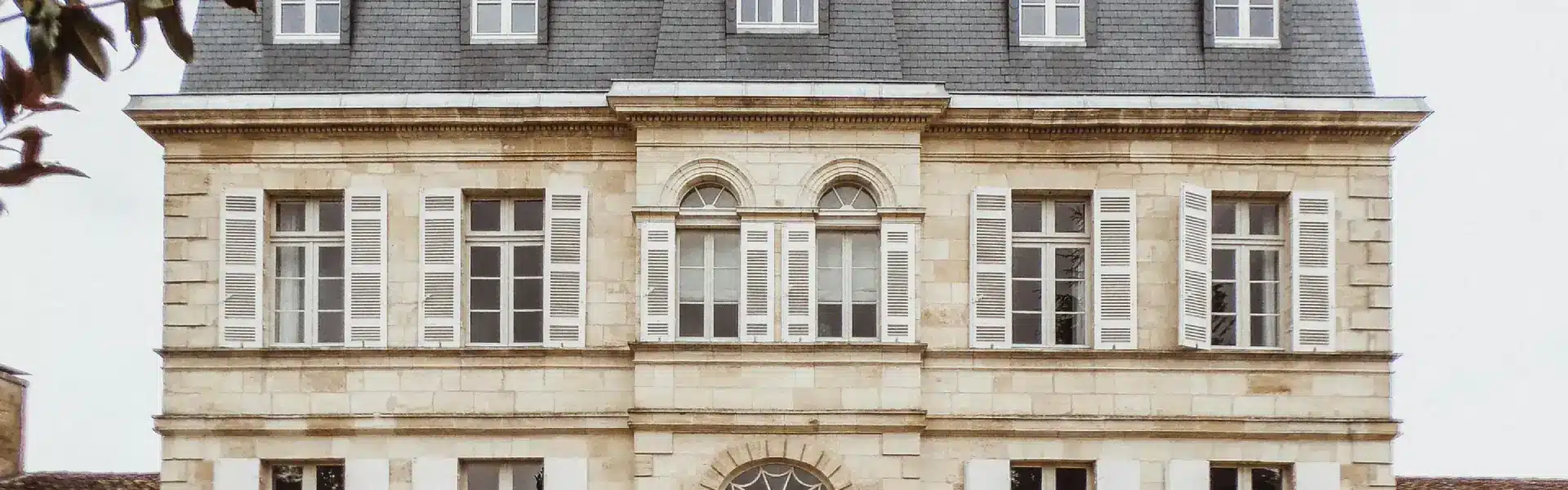
There are houses that announce themselves before you have even crossed the threshold. The wide, self-assured facade. The tall windows, their small panes filtering light in a way no modern glazing can replicate. The interior volumes, generous almost to excess, as though built for a life lived on a grander scale. These are manor houses. And for more than thirty years, I have had the rare privilege of working with them across France, restoring some, reimagining others, and always trying to give them a second chapter worthy of their first.
Designing the interior of a manor house is unlike any other project. It asks you to hold two things at once: a deep respect for what already exists, and the courage to make it genuinely liveable for the people who will call it home today. In this article, I want to share what these houses have taught me over the decades, their particular logic, their demands, and the approach I have refined for bringing them into the present without stripping them of everything that made them worth saving.
Understanding what you have before you change anything
The first and most important step is also the one most often skipped: taking the time to truly understand the building in front of you.
A manor house, known in some French regions as a gentilhommière, is a bourgeois residence built largely between the 18th century and the early 20th century. Its architecture is orderly and symmetrical, its facades finished in dressed stone or regional brick, its interior arranged according to a social hierarchy that no longer exists but whose physical legacy very much does.
What sets a manor house apart from a large old property is the quality woven into every detail: ceiling heights of three to four metres on the ground floor, herringbone or Hungarian-point parquet floors, fireplaces in carved stone or veined marble, original timber panelling, ornamental plasterwork, and moulded cornices that took skilled craftsmen weeks to complete. None of this is decorative in the superficial sense. These elements are the building’s bones. They carry its character, its atmosphere, and much of its value.
When I arrive at a manor house for the first time, the condition and integrity of these features is the very first thing I assess. Are the original floors intact? Do the fireplaces still draw? Has the panelling survived previous renovations? The answers shape everything that follows.
The challenges that define this kind of work
Light: An ally, not an obstacle
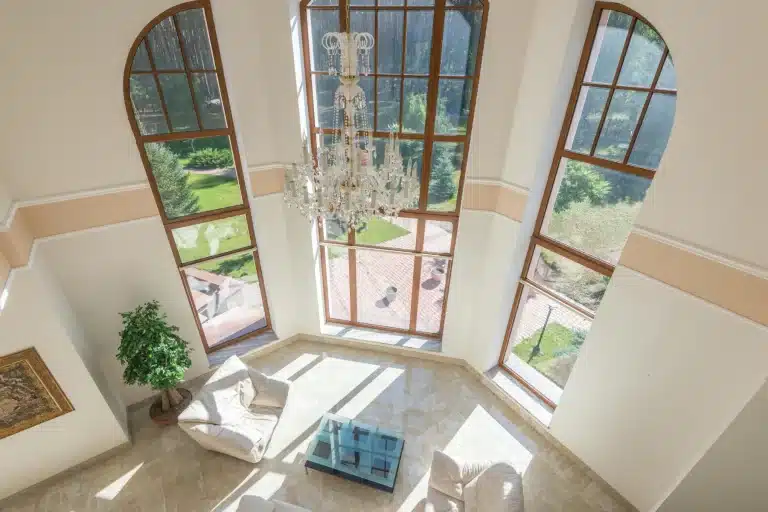
Manor houses were built long before electricity, and their architects understood natural light with an intimacy that modern design rarely matches. Reception rooms were placed to catch the afternoon sun over the garden. Service stairs and utility rooms were pushed to the street side. Windows were positioned in pairs so that light could travel through the full depth of the house, illuminating a sequence of rooms in a single sweep.
Working with this inherited intelligence, rather than against it, is one of the defining principles of my approach. Contemporary artificial lighting must earn its place in these rooms without announcing itself.
Over the years I have developed what I think of as invisible lighting: spotlights recessed into ceiling coves so that the light grazes the walls rather than falling straight down, wall fittings chosen for discretion rather than statement, and pendant lights scaled to converse with the room’s height rather than compete with it.
In one manor house I renovated in Bordeaux, the original oak coffered ceilings ruled out any form of drilling. The solution was a track lighting system concealed entirely within the ceiling coves, flexible enough to be redirected as the use of the room changed over time. Not one period detail was altered. The room gained a quality of light that any museum curator would recognise, layered, purposeful, and alive.
Layout: The courage to leave well alone
Manor houses were built long before electricity, and their architects understood natural light with an intimacy that modern design rarely matches. Reception rooms were placed to catch the afternoon sun over the garden. Service stairs and utility rooms were pushed to the street side. Windows were positioned in pairs so that light could travel through the full depth of the house, illuminating a sequence of rooms in a single sweep.
Working with this inherited intelligence, rather than against it, is one of the defining principles of my approach. Contemporary artificial lighting must earn its place in these rooms without announcing itself.
Over the years I have developed what I think of as invisible lighting: spotlights recessed into ceiling coves so that the light grazes the walls rather than falling straight down, wall fittings chosen for discretion rather than statement, and pendant lights scaled to converse with the room’s height rather than compete with it.
In one manor house I renovated in Bordeaux, the original oak coffered ceilings ruled out any form of drilling. The solution was a track lighting system concealed entirely within the ceiling coves, flexible enough to be redirected as the use of the room changed over time. Not one period detail was altered. The room gained a quality of light that any museum curator would recognise, layered, purposeful, and alive.
Materials: Where quality becomes non-negotiable
Manor houses were built long before electricity, and their architects understood natural light with an intimacy that modern design rarely matches. Reception rooms were placed to catch the afternoon sun over the garden. Service stairs and utility rooms were pushed to the street side. Windows were positioned in pairs so that light could travel through the full depth of the house, illuminating a sequence of rooms in a single sweep.
Working with this inherited intelligence, rather than against it, is one of the defining principles of my approach. Contemporary artificial lighting must earn its place in these rooms without announcing itself.
Over the years I have developed what I think of as invisible lighting: spotlights recessed into ceiling coves so that the light grazes the walls rather than falling straight down, wall fittings chosen for discretion rather than statement, and pendant lights scaled to converse with the room’s height rather than compete with it.
In one manor house I renovated in Bordeaux, the original oak coffered ceilings ruled out any form of drilling. The solution was a track lighting system concealed entirely within the ceiling coves, flexible enough to be redirected as the use of the room changed over time. Not one period detail was altered. The room gained a quality of light that any museum curator would recognise, layered, purposeful, and alive.
Room by room: My advice for designing a beautiful manor house interior
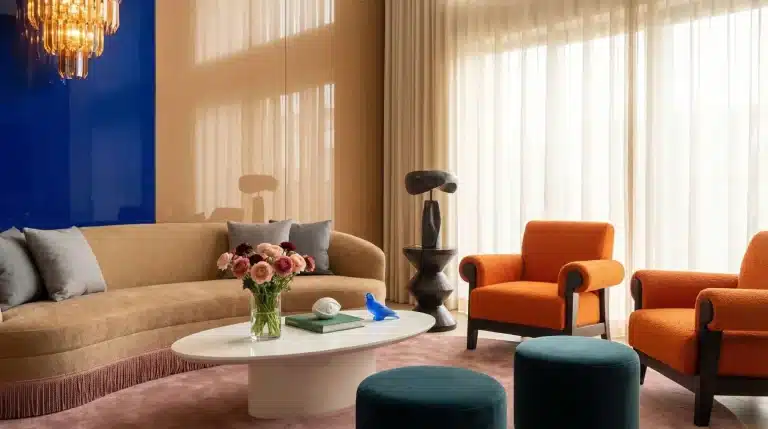
The living room: Setting the tone
Every room in a manor house is significant, but the living room is the one that establishes the register for everything else. It needs to be taken seriously.
That does not mean it should be intimidating or stiff. What it means is that the room should feel considered, composed, and genuinely expressive of the people who live there. The fireplace is almost always the place to start. Even where it can no longer be used, it remains the room’s natural axis, and everything else should be arranged in relation to it. Seating grouped into distinct areas around it, a reading corner here, a spot for conversation there, works well in rooms with generous ceiling heights because the space can absorb that kind of organisation without feeling cluttered.
Colour matters enormously in these rooms. Cold whites flatten the mouldings and drain the plasterwork of its depth. I tend to work with warm off-whites, soft greiges, deep bottle greens, and rich Prussian blues. These are colours with enough body to work with the room rather than against it.
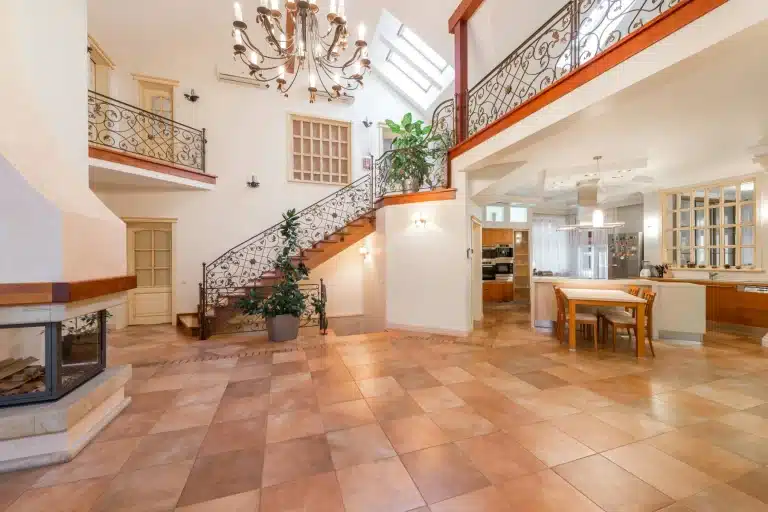
The kitchen: Making modernity feel inevitable
The kitchen is usually where the most dramatic transformation happens. What was once a functional service room, often poorly lit and entirely separate from the life of the house, needs to become something that a contemporary household actually wants to spend time in, without looking as though it arrived from a showroom.
The approach I return to most often is to design cabinetry that feels as though it has always been there. Artisan kitchen makers who work in solid smoked oak, deep matt lacquers, or brushed metal can produce doors that read as furniture rather than fitted units. The worktop material matters enormously at this level: Carrara marble, dark granite, and Burgundy limestone all carry the kind of presence these rooms require.
In a manor house renovation I led in Normandy, the former staff dining room became the new kitchen. Smoked oak fronts, a selection of original-period encaustic tiles used as splashbacks, and a central island in Portoro marble produced a room that felt contemporary in every way while remaining completely at home in the building around it.
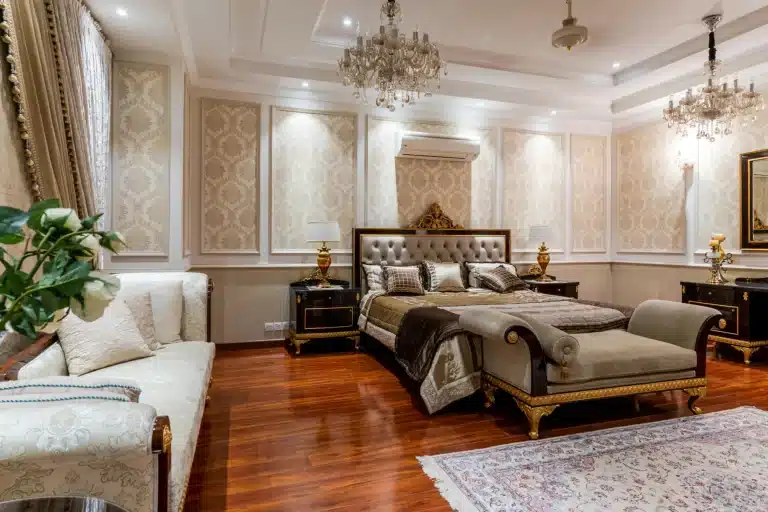
The bedrooms: Intimacy at scale
Manor house bedrooms present a particular challenge. They are often too large and too tall for easy comfort, with windows that let in more light than most people want when they are trying to sleep. The task is to bring warmth and enclosure into rooms that were never designed with those qualities in mind.
A canopied bed or a substantial upholstered headboard can create a room within the room, a contained, human-scaled space that the larger volume wraps around. Floor-to-ceiling curtains soften the acoustics and reduce the sense of exposure. A thick wool rug anchors the sleeping area and gives the foot something warm to land on. The adjoining bathroom, almost always carved out of a neighbouring room, should feel like a natural extension of the bedroom rather than a separate decision.
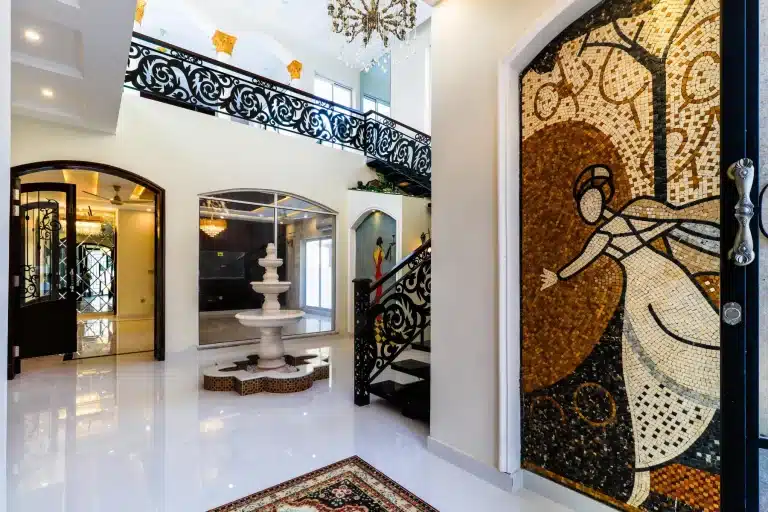
The spaces in between
Entrance halls, landings, and staircases are consistently the most undervalued spaces in a renovation. In a manor house, that is a significant oversight.
The main staircase alone deserves serious attention. Its wrought-iron balustrade, its stone or worn timber treads, the open void that draws the eye upward through the house: these are architectural moments, not merely functional connections between floors. I often use the staircase wall for a large-format artwork, or develop a lighting scheme that makes the act of climbing the stairs feel considered and unhurried.
Two projects, two approaches
Périgueux, Dordogne — 620 m²
A family home that needed to work for three children while remaining true to its exceptional heritage. On the ground floor, two non-structural partitions were removed to open a connection between the drawing room, the library, and the dining room. The Hungarian-point floors were restored and finished with a natural oil. The marble fireplaces were cleaned and brought back to life. A kitchen in natural oak and local Périgord stone was installed in the former service pantry. After six months on site, the house felt entirely unchanged and completely transformed at the same time.
Lyon, 6th Arrondissement — 480 m²
A classically built early 20th-century property acquired by a couple with a serious collection of contemporary art and design. The challenge was to make the collection feel at home without overwhelming the architecture, and to make the architecture feel relevant without competing with the work on the walls. A near-monochromatic palette of warm whites, soft greiges, and natural linen gave the rooms the neutrality they needed. The original panelling, floors, and fireplaces were retained and cleaned rather than altered. The dialogue between old and new was left deliberately visible, and it is all the better for it.
Frequently asked questions
Does everything original need to be kept?
Not always, but nothing should be removed without first understanding why it is there. Some elements are genuinely past saving; others were added in a previous renovation and never really belonged. The important thing is to have someone with the right experience make that call. A well-preserved period boiserie can represent tens of thousands of euros in value. Losing one is rarely a decision you can reverse.
What does a full manor house renovation cost?
Without a proper survey it is impossible to give a precise figure, but as a working guide, a complete high-quality renovation excluding structural work typically runs between €1,200 and €2,500 per m² including VAT. For a 400 m² property, that places the full budget somewhere between €480,000 and over one million euros at the upper end of finish. Those numbers need to be set against the uplift in property value and the longevity of work done properly the first time.
Can contemporary design work alongside period architecture?
It can, and in my experience, it usually works better than trying to replicate the original style faithfully. A manor house decorated entirely in a period idiom can feel like a stage set. One that has been stripped of all its original character in favour of a contemporary look tends to feel adrift. The most compelling interiors I have worked on hold both things in tension, and that tension is precisely what makes them interesting.
What about insulation and energy performance?
This is technically the most demanding aspect of any heritage renovation. The options depend on the specific construction of the building: slim internal insulation systems using aerogel technology, cavity injection where the wall structure allows it, and high-performance glazing units are all possibilities. I work closely with thermal engineers who specialise in period properties. Meeting current energy standards in a manor house is achievable, but it requires solutions tailored to the building rather than lifted from a standard specification.
How long will the project take?
The design and approvals phase typically takes between six and twelve months, depending on whether planning consent or heritage authority sign-off is required. The construction phase then runs from eight to eighteen months depending on the scope of works. The artisan firms whose work is good enough for this kind of project, skilled plasterers, specialist floor layers, ornamental stucco craftsmen, tend to be booked well in advance. Waiting for the right person is always preferable to settling for the available one.
Is an interior designer strictly necessary?
Legally, no. In practice, for a property of this complexity and value, I would argue strongly that it is. Not because the process is beyond a determined owner, but because the margin for error is narrow and the consequences of getting things wrong are expensive. The right designer will save you more than their fee, often considerably more.
What thirty years with manor houses have taught me
Every manor house I have worked in has reminded me, in its own way, that the job is to serve the building as much as the client. These are structures that have outlasted everyone who ever lived in them, and they will outlast us too. They deserve to be approached with that in mind.
My role is not to arrive with a vision and impose it. It is to listen carefully, both to the house and to the people who are about to make it their home, and to find the point where those two things meet. When the result feels as though it could never have been any other way, that is when I know the project has worked.
If you own a manor house and are beginning to think about what it could become, I would be glad to hear from you.
Laurent Gallé is a luxury interior designer based in Paris, with more than thirty years of experience in the renovation of exceptional period properties across France and Europe.