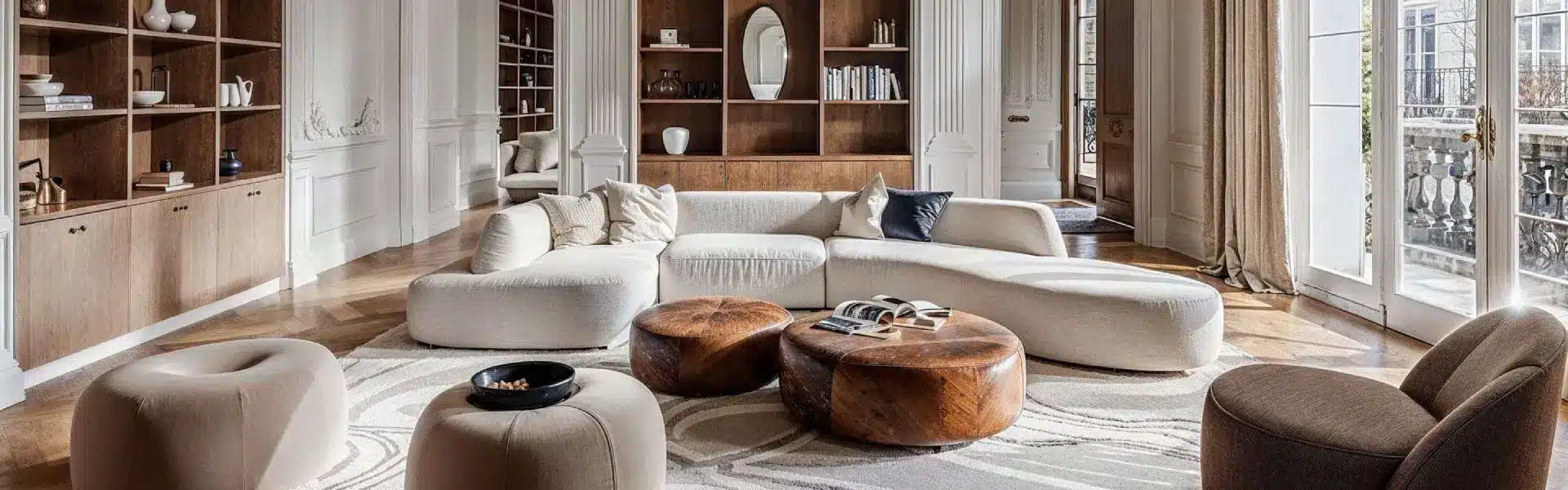

Author: Laurent Galle, Interior Architecture and Decoration Studio
Reading time: 4 minutes | Date: December 2025
In 2026, interior architecture in France is turning the page on cloned beige-grey interiors. The leading design magazines are declaring the end of the “faux Mediterranean” look and standardised décor, in favour of spaces that are more personal, more colourful, more sustainable, and far more individual.
In this shifting landscape, certain interior architects are asserting a strong and distinctive vision.
Here is an overview of the top 10 interior architects to follow in France in 2026.
Why these 10 interior architects matter in 2026
The French interior architecture market is professionalising at considerable speed. Driven by publications such as AD, Elle Décoration, and Marie Claire Maison, private clients are increasingly well-informed, increasingly demanding, and increasingly willing to invest in a genuine, holistic project rather than a simple cosmetic refresh.
Three major trends are shaping 2026:
- The end of copy-paste interiors: the professionals interviewed by AD point to a growing disenchantment with tepid beiges, false Mediterranean references, and interiors that photograph well but lack soul. In their place: bolder palettes, stronger contrasts, and a personal narrative woven through every project.
- The return of material substance: solid timber, stone, lime plaster, heavy textiles, artisan-made pieces. Natural materials, already prominent for several years, are gaining further ground, with heightened attention to provenance, durability, and tactile quality.
- The holistic “art of living” project: the interior architect is no longer focused solely on a sitting room or a kitchen, but on the entire living experience: light, acoustics, circulation, made-to-order furniture, works of art, and sometimes even the household linen.
In this context, the most compelling interior architects to follow are those who manage to hold together artistic vision, everyday comfort, and environmental awareness, while appealing to French clients and international markets alike, from the United States to the Middle East to Asia, all of which retain a strong appetite for that distinctly French sensibility.
Laurent Galle: Interior design as an art of living
Among the signatures to watch closely in 2026, Laurent Galle occupies a place of his own. His studio, founded in Paris in 1993, has been built on a clear and consistent vision: to create refined, timeless interiors that speak more to the “art of living” than to passing trends.
Today, Laurent Galle Design works in France and internationally, across Parisian apartments, villas, and high-end hotels, with an aesthetic that is immediately recognisable:
- warm, sophisticated colour palettes,
- an extraordinary attention to proportion, perspective, and the flow of movement through a space,
- a selection of furniture and made-to-order pieces that creates an atmosphere at once generous and fully controlled.
One of the studio’s defining strengths is its ability to translate each client’s way of life into an interior: Parisian families, international collectors, hoteliers, investors. The common thread, however, remains constant: a discreet elegance, never ostentatious, in which decoration is always at the service of well-being.
For those wishing to develop a high-end project, particularly in Paris, Laurent Galle positions himself as an interior architect capable of leading a project in its entirety, from the structural work through to the last decorative detail.
India Mahdavi: Colour as a manifesto
It is impossible to speak of French interior architecture without mentioning India Mahdavi. Celebrated for years by AD and the international design press, she stands as the pre-eminent reference for colour, graphic boldness, and a certain joyful spirit of French luxury.
In 2026, her work continues to shape an entire generation: pastel cafés, hotels with vibrant palettes, iconic retail environments. Her particular strength lies in creating powerful, almost cinematic worlds that remain, against all expectation, extraordinarily liveable.
Pierre Yovanovitch: Sculptural, architectural, utterly controlled
Pierre Yovanovitch is among the most sought-after French interior architects, both in France and in the United States, where he signs spectacular penthouses and apartments.
His style: highly architectural volumes, a love of curved forms and sculptural furniture pieces, and a palette that is subtle, often soft, but never flat. In 2026, he remains the definitive reference for those who love sophisticated interiors that sit close to auteur architecture.
Laura Gonzalez: The scenographer of living spaces
A star interior architect of numerous restaurants, hotels, and boutiques, Laura Gonzalez has made her name through her ability to tell visual stories in every space she touches, notably in New York, where her work has received extensive coverage.
Her projects blend classical influences, bohemian touches, richly worked decorative details, and a strong artisanal dimension. In 2026, her world continues to inspire both residential projects and high-end commercial spaces alike.
Dorothée Meilichzon: Hospitality as a creative laboratory
Founder of the agency CHZON, Dorothée Meilichzon has redefined the aesthetic of Parisian and European boutique hotels with narrative, warm, and richly drawn interiors. Her projects, regularly published in the design press, have profoundly shaped client expectations among those in search of spaces truly conceived for living, rather than simply for show.
Tristan Auer: Classicism reinvented
Tristan Auer is one of the masters of contemporary neo-classicism: cornicing, panelling, noble materials, all revisited with more fluid lines and an acute sensitivity to light. His projects for palaces, private residences, and yachts speak to a clientele that loves luxury in its most sophisticated form.
Gilles and Boissier: The duo with an international reach
The duo Gilles and Boissier (Patrick Gilles and Dorothée Boissier) sign interiors for restaurants, hotels, boutiques, and residences the world over. Their style, at once graphic and warm, is regularly featured in the special design issues of the leading international magazines.
In 2026, their ability to move fluidly between intimate residential work and major brand projects makes them essential figures for understanding the French scene.
Charles Zana: The architect-collector's eye
Architect and interior architect, Charles Zana is particularly recognised for his Parisian apartment and villa projects, in which contemporary art plays a central role. His published work demonstrates with great consistency how to integrate artworks, collectible furniture, and architecture into a wholly coherent whole.
Batiik Studio: The new graphic wave
Among the rising generation, Batiik Studio (founded by Ksenia Kovalova) is well worth following for its love of graphic lines, confident colour choices, and considered material combinations. Their work reflects the desire, among a younger clientele, for characterful interiors conceived as genuine personal statements.
Maison Sarah Lavoine: A global lifestyle with broad appeal
While Maison Sarah Lavoine is also a decoration brand, the studio’s interior architecture practice plays an important role in defining a certain “Paris Right Bank” style: deep colours, warm timber, clean lines. The residential and commercial projects signed by the studio inspire a wide audience of private clients, who often draw on the brand’s furniture and object collections in parallel.
What these 10 interior architects tell us about the French market in 2026
Looking across these ten signatures, a number of constants emerge:
- A deep porosity between decoration and architecture: interiors are conceived as coherent wholes, from the electrical plan through to the choice of door handles.
- The return of craftsmanship and one-of-a-kind pieces: ceramicists, metalworkers, upholsterers, and fine cabinet-makers are finding renewed visibility through made-to-order projects.
- The international dimension of the profession: many of these interior architects work as readily in Paris as in London, New York, Dubai, or on the Riviera, demonstrating that “French taste” remains in strong demand on the world stage.
In this context, the positioning of Laurent Galle is particularly compelling: his studio embodies a very legible French aesthetic, elegant, warm, and timeless, while developing projects for international clients who wish to bring a certain idea of Parisian refinement into their own homes.
FAQ: how to choose your interior architect in 2026
1. How do you choose an interior architect in France in 2026?
Begin by looking at the completed projects published on the architect’s website and in the design press: this will give you a clear sense of their style, their level of finish, and the coherence of their work over time. Also verify their ability to manage a full project, including engineering consultants, partner contractors, and site supervision, and always ask for references from recent clients.
For a high-end project in Paris or elsewhere in France, a studio such as Laurent Galle Design offers the advantage of long experience (established since 1993) and a comprehensive approach, from interior architecture through to decoration.
2. What are the key design trends for 2026 to consider for my project?
Experts point to the end of overly beige palettes, the confident return of colour, the use of natural materials such as timber, stone, and heavy textiles, curved and enveloping forms, and a growing desire for more authentic interiors that feel genuinely lived-in rather than picture-perfect.
The challenge is not to copy a trend, but to understand how your interior architect can adapt it to your particular way of life and your specific space.
3. How much does an interior architect cost in France?
Fees vary according to the architect’s profile, the complexity of the project, and the level of involvement required. The most common structures are:
- a percentage fee calculated on the total works budget, typically between 8% and 15% for full project management,
- or fixed study fees covering plans, 3D visuals, and mood boards, complemented by a separate site supervision service.
An experienced studio positioned at the high end of the market, such as Laurent Galle’s, tends to sit towards the upper end of this range, in keeping with the quality of service and expertise provided.
4. Why follow interior architects on Instagram and in the design press?
Because it allows you to:
- identify the aesthetic languages that genuinely resonate with you,
- see how trends translate into real, finished projects,
- recognise consistent signatures that stand the test of time, well beyond the reach of any passing fashion.
The accounts of studios such as those of India Mahdavi, Pierre Yovanovitch, and Laurent Galle are exceptional sources of inspiration for preparing your own project.
How to work with a studio like Laurent Galle
The most productive starting point is to prepare:
- a realistic budget and a clear works envelope,
- a file containing existing floor plans, photographs, and technical constraints,
- a list of your requirements: number of occupants, daily routines, entertaining habits, storage needs, home working arrangements, and so on.
During the initial exchanges, the studio will help you to prioritise, to clarify the scale of intervention required, whether a straightforward reorganisation or a comprehensive redesign, and to define a realistic timeline. Laurent Galle’s approach rests on a deep dialogue with each client, with the aim of creating an interior that is a genuine reflection of who they are, without ever compromising on elegance or the overall coherence of the project.
Why following trends matters for your project
Following these 10 interior architects in 2026 means following the evolution of an increasingly demanding French market, as noted by Morgan Richez, Development Director at Laurent Galle, in which interiors are no longer simply beautiful in photographs, but designed to be lived in, and loved, for years to come.
And if you are looking for a signature capable of embodying that subtle balance between comfort, sophistication, and the French art of living, the work of Laurent Galle deserves a prominent place at the top of your list.